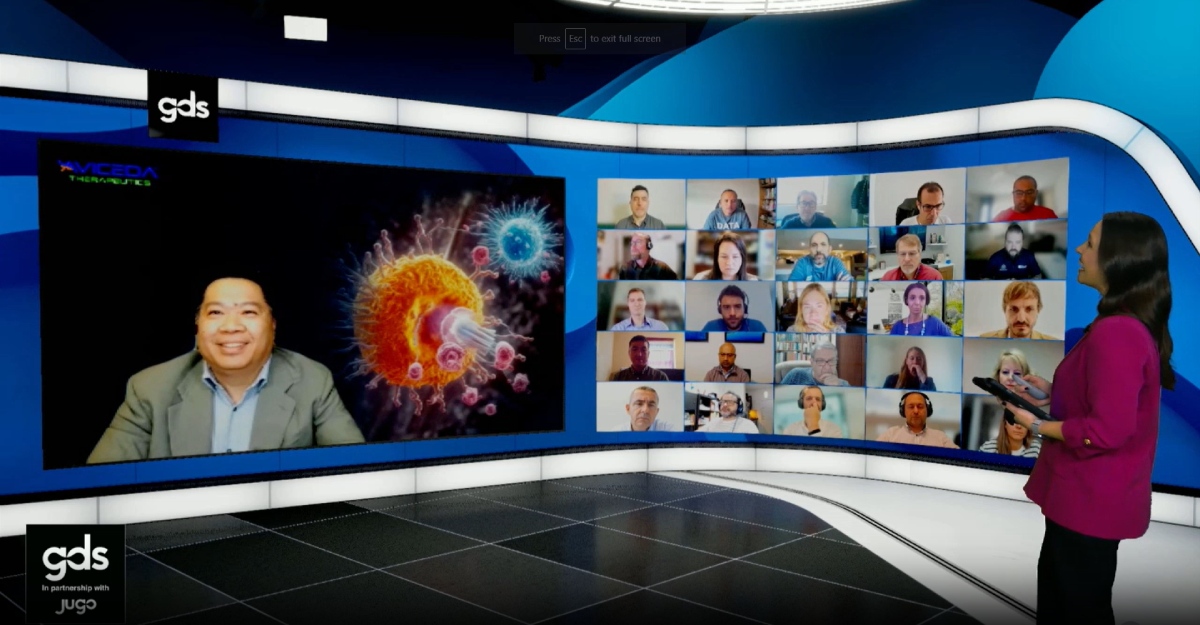
A standout session at our recent GDS Life Sciences Summit was a keynote address featuring purple M&M’s and the remarkable research being done to cure the world’s most complex diseases.
Industry leaders from all over North America attended the summit to learn and hear new insights from experts and innovators. One of those innovators is Dr. Michael Tolentino, Co-Founder & CIO at Aviceda Therapeutics.
Dr. Tolentino’s life’s work is to cure blinding diseases and cure cancer.
As I listened to Dr. Tolentino tell his story, I could feel the inspiration rising. Get inspired with us, as we take you through the fascinating story.
 Dr. Tolentino radiates positive energy as he shares his learnings.
“The only conclusion is that we will be able to cure cancer.”
– Michael Tolentino, MD, Chief Innovation Officer & Co-Founder, Aviceda Therapeutics
A family legacy
Dr. Tolentino has been dreaming about curing blindness and stopping cancer since he was a child. His father was a pioneer in the field of retinal disease – disorders that damage the retina and often lead to blindness.
He explained how his father would bring his research home with him, and before the younger Tolentino could even attend a PG-13 movie, he pitched right in.
“I come from an Asian family. So, if your parents run a Chinese restaurant or run a laundromat, you end up working there,” he said, smiling. “In line with the culture, I ended up working in the family business since I was probably around 8 to 10 years old.”
A simple analogy
It was during this time, helping his father work on retinal detachment, that Dr. Tolentino learned the power of simplifying a complex problem.
“When I was working in my father’s Lab at Harvard Medical School as a 10-year-old,” he recalled, “my father simplified the problem for me by analogizing the retinal detachment to wallpaper falling off the wall.”
He watched, and even helped, as this novel view of a detached retina led to his father developing a new surgery to better treat the condition. He likened the method to pushing the wallpaper (the retina) back onto the wall (the eye).
Having witnessed the success of this way of thinking, Dr. Tolentino says he set about solving more medical problems with the same structured approach.
Simplify to innovate!
- Take a complex problem
- Simplify it with an analogy
- Solve the analogous problem
- Use the latest technology to implement that solution for the complex problem
In time, Dr. Tolentino was indeed able to use this framework to successfully treat other medical problems, including wet macular degeneration, a condition the National Eye Institute (NEI) says impacts 11 million people in the US alone.
“Simplifying the problem has really led to several treatments for wet macular degeneration that is saving vision around the world,” he said.
The purple M&M analogy and Aiko, the dog that chews
The next challenge was solving dry macular degeneration, a condition the NEI says often progresses to wet macular degeneration. Even if you’re familiar with the disease, I bet you’ve never heard the disorder described the way Dr. Tolentino describes it.
“The underlying problem of dry macular degeneration was actually the immune system ‘eating’ the retina. I called it a form of inflammatory cannibalism. Inflammatory cells were ‘eating’ what they were not supposed to be eating—just like my dog, Aiko, who chews on everything and anything that she sees.”
So, how would you correct a dog that likes to chew? “My solution for Aiko’s problem,” he said, “was to train her what to eat, and to spray something called ‘No Chew’ on the objects that I did not want her to eat.”
Applying this rationalization toward the human body and thinking of the immune system as having ‘taste buds’.
“Every cell in the human body looks like a peanut M&M,” he declared. “They have a ‘peanut’ core, called the nucleus; a ‘chocolate’ surround, called the cytoplasm; and a ‘sugar coating,’ called the glycocalyx.”
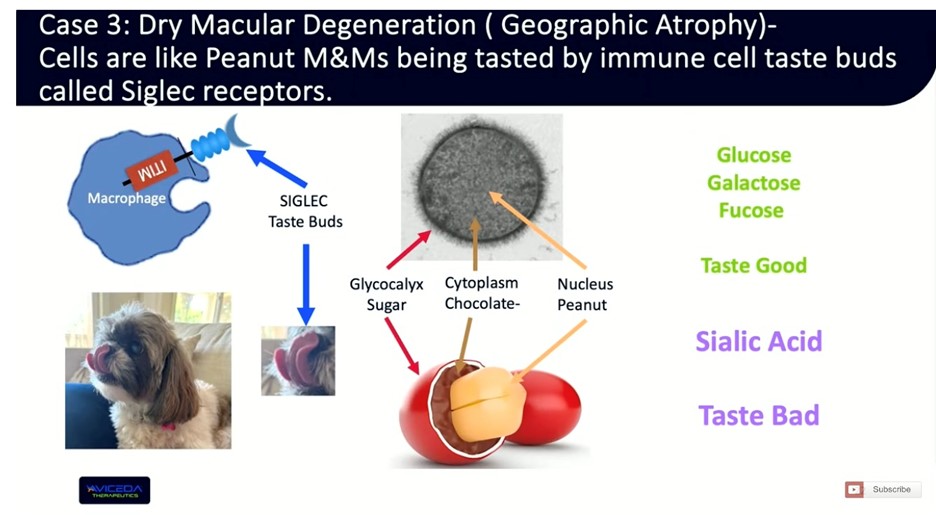 A slide from Dr. Tolentino’s presentation
Here’s where the M&M comparison gets interesting. According to Dr. Tolentino, cells have some ‘sugar coatings’ that taste good to immune cells, and some ‘sugar coatings’ that taste bad.
“Healthy cells are coated with sialic acid, or ‘sugar,’ which tastes bad to immune cells, and actually makes them lose their appetite,” said Dr. Tolentino.
However, he said, the other ‘sugars’ taste good to immune cells, which encourages the ‘eating’ of the retina.
“So, knowing this, we developed a ‘purple M&M,’ which signifies the sialic acid-coated nanoparticle that makes the immune cells lose their appetite. If they do not devour the retina, then the retina becomes happy, and sees better.”
With this purple M&M development, Dr. Tolentino and his co-founders launched Aviceda Therapeutics, a late clinical-stage biotechnology company.
“We have just finished part-one of our phase-two clinical trials and have seen some remarkable results.”
M&M’s & cancer
You may already be thinking: if the purple M&M’s protect cells we don’t want eaten, what about the cells we do want devoured?
“Cancer cells cover themselves with the same purple sugar coating,” said Dr. Tolentino. “What this does is it makes immune cells lose their appetite so the cancers can evade immune destruction. They grow, uncontrolled, and kill the patient.”
“The two ideas that I have come up with are: one, to remove the purple sugar so that the cancers become appetizing again to immune cells,” he said. “The other way is to train the immune cells by blocking their taste buds, so they will eat the cancer.”
I asked Dr. Tolentino, if the solution really is “simple,” why haven’t we cured cancer yet?
“Mainly because of technology,” he answered. “Technology hasn’t caught up to our ability to manipulate the ‘taste buds’ of immune cells.”
But he’s hopeful it’s on the horizon.
“Cancer is a complex problem, but if you look at it from the perspective of a peanut M&M, and you are working with the world’s foremost M&M ‘chefs,’ the only conclusion is that we will be able to cure cancer. So, let’s cure cancer.”
Watch Dr. Tolentino’s full presentation here:
Join us at our upcoming GDS Healthcare Summit to collaborate with leading healthcare professionals and find out what the future holds. We can’t wait to see you there!