Healthcare as an industry is old and slow. Shackled by regulations, burdened with legacy systems, and overwhelmed by critical data. When your industry is years behind the curve, where do you even start when trying to innovate?
At our recent Healthcare Summit, innovation was at the forefront of conversations. Will AI save the day? Is data the answer? For every discussion there was a clear undercurrent for leaders—what do the patients need?
Patient Centricity & Healthcare Innovation
Prioritizing patient centricity can lead to the development of processes that are more credible and truthful. But what is patient centricity? Dr. Anthony Yanni, one of our keynote speakers, summed it up nicely.

Yanni quickly added that “it also involves understanding patients beyond clinical trials, considering their real-world experiences and situations.” As great as it sounds, ‘patient centricity’ is not just a buzzword. For organizations today, this represents a fundamental change in how healthcare should be approached.
When it comes to putting the patients at the heart of everything, unsurprisingly, the patients themselves are leading the charge.
The Patient-Driven Revolution
Patients are no longer passive in the healthcare equation. They are more informed than ever, and they want more control over their experience. Where traditional healthcare models often center around the provider, the future belongs to organizations that prioritize patient-driven care.
To innovate effectively in healthcare today leaders need to ask how they can empower their patients to take control of their own healthcare. For some of our audience, this approach was already taking shape in a variety of ways.
- Leveraging data collected from wearable devices helps organizations to better personalize care plans.
- Offering more options for patients to engage with their physicians such as virtual consultations allow organizations to meet the increasing demand for accessible care.
- Making it easier to book appointments, get results, manage prescriptions reduces the administrative burden and streamlines patient care.
People’s expectations are changing. Leaning into that and integrating patient needs as a driver of innovation will improve not only the patient experience, but care outcomes as well.

The Importance of Data
To address the specific needs of their patient populations, organizations need to dive into their wealth of data.
Data is a powerful tool for innovation but there can be too much of a good thing. There is so much data in healthcare that most organizations are simply too overwhelmed to make informed decisions. Fortunately, once again, the experts from our Healthcare Summit had some advice.
- Break down your data silos. Data being scattered to the winds makes it impossible to create a holistic view of patients that incorporates their electronic health records (EHRs), data from wearables, or even survey results.
- Standardize your data formats. This ensures that data can be interpreted correctly and effectively.
- Close the loop! Integrate analytics into your workflows to enable real-time decision making for improving care.
Data is the key to understanding and unlocking patient-centric care. With it, organizations can identify areas for improvement, optimize processes, and create innovative opportunities for addressing the needs of their patients.
High Tech, High Touch
Technology has a crucial role to play in the patient-centric model. Start by reframing technological innovation as a mechanism for enhancing human interaction, not replacing it.
A great example of this is telemedicine—a technology that offers a new avenue for patient care without sacrificing the patient connection.
We’ve already heard how AI can tackle some of the human challenges around healthcare and actually improve patient/physician connections.
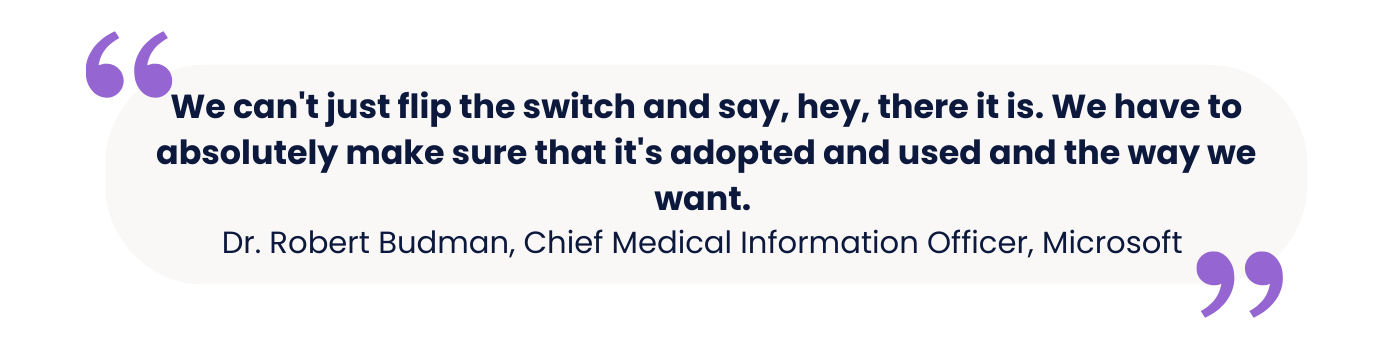
Technology exists today that can elevate healthcare for patients and practitioners alike, but always remember that technology is only as effective as the people using it. To really drive innovation, leaders need to foster an innovation culture that invests in training and upskilling their staff.
Healthcare Innovation
Innovation culture in healthcare is a complex but essential undertaking. Healthcare can not afford to languish behind other industries any longer. By prioritizing patient-driven care, data-driven decision making, upskilling staff, and fostering a culture of change, healthcare organizations can position themselves for success in a turbulent healthcare landscape.
Embrace innovation, empower your staff, and put patients at the center of everything you do.
For more insights on the future of healthcare and to join the conversations shaping it, check out our upcoming Healthcare Summit this April.
To see all our upcoming summits, please see our events page.