Being a CIO in 2025 is tough.
As a baseline, you need the technical chops to understand your enterprise architecture: how systems speak to one another, how data flows across the organization, and how processes work together.
You also need to understand the business: what goals you are collectively trying to achieve, and the role that technology plays in enabling those outcomes.
And of course, keeping a handle on the (often overwhelming) raft of new developments coming over the horizon is a constant concern. From AI, to data streaming, to quantum computing—the world of enterprise technology is moving faster than ever (do keep up at the back).
Understanding what to work on next, in order to deliver maximum value to the business, is paramount. Which means that prioritization is rapidly emerging as a critical skill for CIOs in 2025 and beyond.
And not just any old prioritization. In order to meet that rapid pace of change and deliver on your modernization agenda, what’s called for is dynamic prioritization.
ROI Versus Innovation
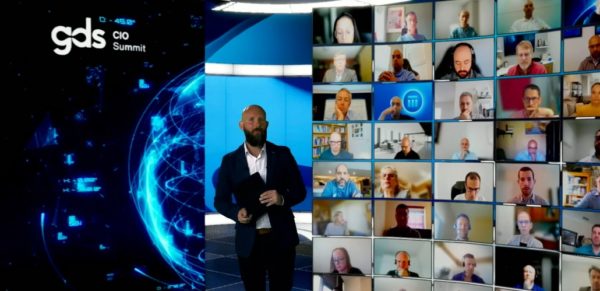
It was a key discussion topic for attendees at the recent CIO Insights Summit, hosted by GDS Group, in Noordwijk in The Netherlands.
“Business stakeholders increasingly expect a return on investment,” explains Angelika Trawinska van Bolhuis, CIO for EMEA at Dyson. “And I think that is something that IT leaders still struggle to deal with. How much do we invest in the initiatives that show ROI, versus the initiatives that have potential but are largely unproven?”
Claudio Finol, Chief Innovation & Strategy Officer at Fyffes, agrees.
“Every day, in every business, there’s this conversation about competing priorities. The key question for me is, how do we carve out maybe 20% of our IT time and resources to focus on developing new things that would offer a competitive advantage?”
Claudio Finol, Chief Innovation & Strategy Officer, Fyffes
It’s the age-old dilemma: how to change the business whilst at the same time running the business. And as Finol points out, CIOs have to be diligent about ringfencing the former, because every quarter there’s the threat of “ok, but not now” – where innovation budgets get redirected to operational areas as plans and requirements shift.
So how do CIOs keep all those different plates spinning?
Understanding the Impact
This is where dynamic prioritization comes in.
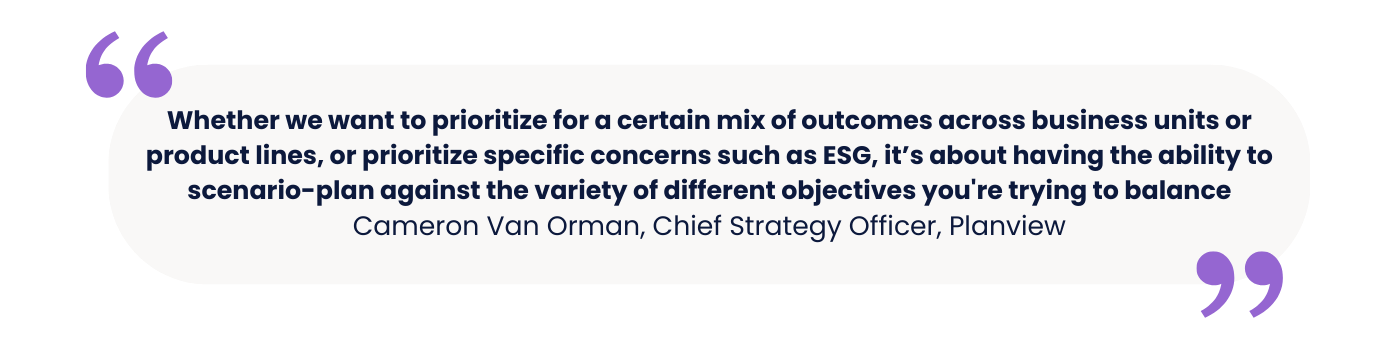
“There are always lots of things we could do, but we have constrained resources – budgets and humans and skills – to implement them all,” suggests Cameron Van Orman, Chief Strategy Officer at software firm Planview. “So we spend a lot of time on a very purposeful prioritization process where we surface what we need to work on next.”
For Van Orman, that means gathering ideas from across the business and assessing their potential impact under different scenarios. “We crowdsource ideas – because execs don’t always have the monopoly on innovation – filter them, then start to plan against them,” he explains. “What resources are required? What are the attributes that matter? What’s the short-term cost? What’s the long-term return?”
With that baseline data in place, the team can then start comparing for different value sets. If the business wants to optimize projects that offer short-term returns, what would the portfolio of initiatives look like? If it were to optimize for the long-term, how would that change things?
Shifting the Mindset
Prioritizing the right IT investments and decision-making is a complex but essential task. It means aligning IT with business strategy. It involves balancing operational excellence and innovation. And it will require us to embrace dynamic new processes and leverage real-time data.
For Angelika at Dyson, meeting those goals is about partnership.
“Instead of being passive recipients of the business strategy and simply putting it into action, we need to be co-creators of it. We need to better define what the role of technology could look like from a strategic advantage perspective.”
Angelika Trawinska van Bolhuis, CIO for EMEA, Dyson
Finol has a similar take. “There’s this real debate between operational excellence on the one hand, and the potential to create new sources of revenue on the other,” he suggests. “And that requires us to be more proactive, rather than just sitting back and waiting for the business to come to us. Every company has a strategic objective, and technology is there to help achieve those objectives faster.”
As we navigate an increasingly complex landscape of competing priorities, limited resources, and the need for rapid adaptation to ensure their organizations remain competitive, understanding where to focus attention remains one of the most critical elements to get right.
“Ultimately, our job is to prioritize to what matters most. Do we want to increase our ratio of investment towards decreasing risk? Do we want to reduce our technical debt? Or increase our ratio towards developing new functionality? There is no right answer, it depends on the environment, the time, the competition, whether you’re looking short-term, long-term, whatever. But being able to look at and answer those questions – and do it dynamically, in real-time – is what gives you a shot at delivering against those objectives.”
Cameron Van Orman, Chief Strategy Officer, Planview
Ben Thompson, Writer, Editor, Public Speaker, Digital Transformation SME, and GDS Summit Host.
To attend GDS Group’s next CIO Insight Summit and learn more about how CIO’s are responding to a rapidly changing world, please visit here.