
Tantalized by the promise of AI but stuck in “pilot hell”? You’re not alone! Moving AI initiatives from experimentation to measurable success is a challenge facing CIOs all over the world. Fortunately, the speakers and attendees at our latest CIO Insight Summit were more than happy to share their insights on how they are making AI work.
Define a Grounded Vision
All too often AI is seen as a golden goose—limitless possibilities and the solution to all your problems. There may come a day when AI simply sweeps in and sends us all home but today is not that day. For now, successful AI adoption starts with a clear purpose and alignment with business goals.
In his keynote session, Crafting an AI Strategy That Delivers Real Impact, Rajeev Sinha, the Chief IT Enterprise Architect at Pacific Gas & Electric Company, emphasized the importance of having a clear direction:
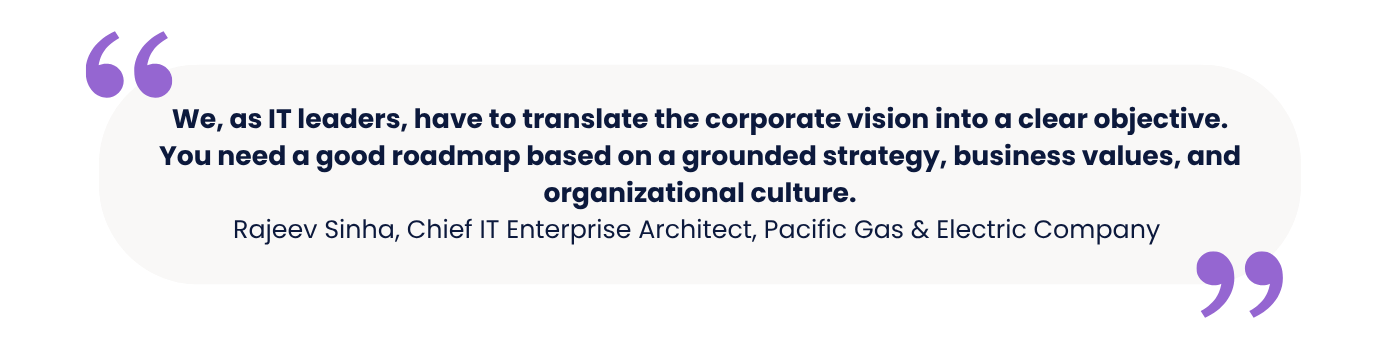
He followed up with a very simple summation of the problem, “If there is no direction, you cannot measure impact.”
There is no one-size-fits-all approach for AI. Each individual organization needs to carefully interrogate their own needs and objectives before buying-in to any AI project.
Identifying Value and Selling it to the Business
Value is all about prioritization. A value framework, even one as simple as plotting value vs. feasibility, helps evaluate and prioritize use cases based directly on business impact.
In his masterclass, IT Strategist, Data & AI Leader Murtaza Cherawala, shared a simple scaffold for establishing value with AI:

A key obstacle standing in the way of value delivery is the inability to connect AI goals to measurable impact. By quantifying potential benefits, such as hours saved or ROI, IT leaders will make value more tangible for stakeholders.
Know Your Risk
No conversation around making AI work is complete without understanding your risk. Our community were unanimous when they said, “implement your AI governance early!”
Every AI solution and proposal must be assessed against a risk framework. It sounds almost insultingly simple, but you’d be surprised how quickly common sense goes out the window when an exciting new toy comes along.
While many will start by writing policies, the challenge lies in the governance side of things and how to govern effectively to avoid unintended outcomes. This includes establishing centralized governance so that you can ensure any AI is being used responsibly.
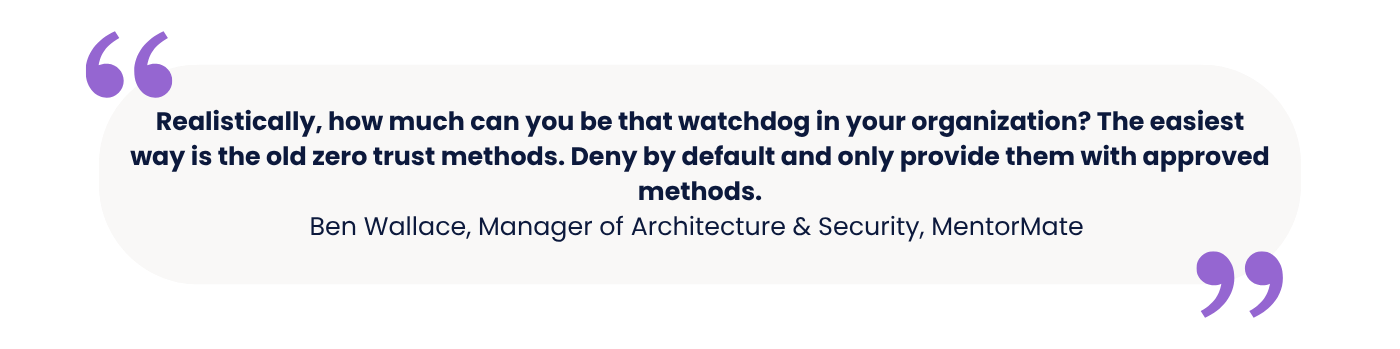
Whenever thinking about AI, remember to loop in your CISO. Secure practices like zero trust can help contain AI use within approved environments.
The Foundational Pillars of AI
Data
If we had a dollar for every executive who stressed the importance of data as the foundation of AI, we’d have many, many dollars. And yet, it’s still a sticking point. You can’t reap the rewards of AI without sowing the data seeds. Data quality, robust data architecture, and effective data governance aren’t nice to have, they’re mandatory.
System Architecture
Another pillar is your engineering and architecture. Sinha suggested that most organizations would need to “rethink their existing engineering and DevOps practices” if they wanted to implement AI. Technical feasibility is a classic challenge often resulting from rushed decisions. As part of a panel on being smart with AI, Josh Angotti, VP of Product Development at Windstream recommended his strategy for AI architecture:

Your Organization
The final pillar is perhaps the trickiest, and the least spoken about—your organization. Talent deficits, siloed teams with divergent priorities, and a general lack of enterprise-level thinking are death knells for AI. Even with a strong strategy, data, architecture, and governance, AI initiatives will fail if they are not adopted by the people who need to use them.
As such, preparing your organization for the changes AI brings is a step you can’t afford to skip.
Cultivating Talent, Culture, and Adoption
Scaling AI successfully requires investing in your people. By fostering a supportive culture, and managing change to build trust, you can more effectively drive adoption while addressing concerns around AI.

Organizations must break down silos, educate employees on AI’s value, and focus on practical, frontline use cases to accelerate impact. Empowering teams through democratized access, while maintaining governance, and leading with empathy are key to overcoming resistance.
It’s not enough to follow the same steps as always. AI demands deeper stakeholder engagement and tailored change strategies beyond traditional IT approaches.
Making AI Work
The difference between scaling AI successfully and falling short often comes down to mindset. AI should be treated not as a futuristic magic bullet, but as a practical tool. That means focusing on operational use cases and approaching deployments with common sense. Above all, you need a willingness to pivot quickly if value isn’t there.
Organizations that succeed are those that treat AI as a core business initiative, not a series of isolated IT experiments. CIOs need to break free from outdated processes, AI demands we rethink our development frameworks and continuously evolve both the infrastructure and the team behind it.
Making AI work isn’t a one-and-done project. It’s an ongoing journey of integration, learning, and refinement. Companies that commit to this mindset—grounded in value, driven by data, and supported by the right culture—won’t just be ready to scale. They’ll be built for it.
To continue exploring how your peers are navigating these challenges, and shaping what’s next, join us at one of our upcoming CIO Insight Summits.
To see all our upcoming summits, visit our events page.