
If you’re leading customer experience (CX) today, you already know the pressure: deliver faster resolutions, anticipate needs, and do it all with fewer resources. AI is incredibly valuable in customer experience, but its impact depends on where you are on the spectrum, and most organizations aren’t ready to unlock its full value.
Brad Murdoch, the CEO of Deskpro, a leading CX and helpdesk platform, explained,
“AI is only as smart as the information it can access. Most support teams struggle because their knowledge is scattered across wikis, old documentation, email chains, and even people’s heads.”
He broke down thinking of AI as a staged evolution where data, training, and governance matter as much as the technology itself. Understanding the five levels of CX AI maturity helps you see where you are today, what’s holding you back, and how to take the next step forward.
We polled CX leaders and 56% said they were only at level 2, with 33% saying they were at level 3. Where is your organization?:
Level 1: Reactive — Early Experiments:
This is where many organizations start: FAQ bots, grammar-check tools, maybe a chatbot running in one silo. Useful? Yes. Transformative? Not yet. At this stage, the real value is building familiarity and spotting opportunities to scale.
Level 2: Organized — AI with Guardrails:
Now AI starts assisting agents with ticket summarization, suggested responses, and predefined chat flows. Governance frameworks begin to appear, helping leaders manage risk. The value here is efficiency—agents get more time to focus on nuanced interactions while AI handles the repetitive work.
Level 3: Strategic — Smarter CX with Intent Detection:
AI begins to sense context: routing tickets intelligently, detecting customer intent, and pulling from integrated knowledge bases. This is where the data readiness gap really shows itself.
“Before you can get value from AI, you often need to solve fundamental data and knowledge management problems that have been years in the making,” Murdoch added.
CX leaders at this level see the payoff of organizing their knowledge and securing clean, structured data.
Level 4: Intelligent — Omnichannel, Human-Like Conversations:
Multi-agent orchestration across chat, voice, and email. Sentiment analysis. Enterprise integrations. Customers feel like they’re speaking to a brand that truly understands them. For CX leaders, this is where AI moves from a cost-saver to a customer loyalty driver.
Level 5: Autonomous — The Future of CX:
The vision many leaders chase: AI that independently handles complex interactions, predicts issues before they surface, and continuously optimizes. Here, AI becomes not just a tool, but a strategic decision-maker. Few organizations are here today, but it’s the direction the journey leads.
A Simple AI Level Up Assessment to do Yourself:
When you think about your own organization, ask yourself:
- Customer Request Management→ Are your queues and routing optimized? Do you truly support customers across multiple channels?
- Data Sources→ Are they up to date, indexed, and accessible to AI—or still scattered and incomplete?
- (Human) Agent Training→ How comfortable is your team with new AI tools, and do they trust them?
- Data Security→ Can you confidently protect sensitive customer data when AI is in the loop?
- Leadership Support→ Does leadership back AI adoption with realistic expectations, or are they pushing for rapid ROI without the right foundation?
Reflecting honestly on these questions can help you see where you stand on the AI maturity spectrum—and what needs to change before you can level up.
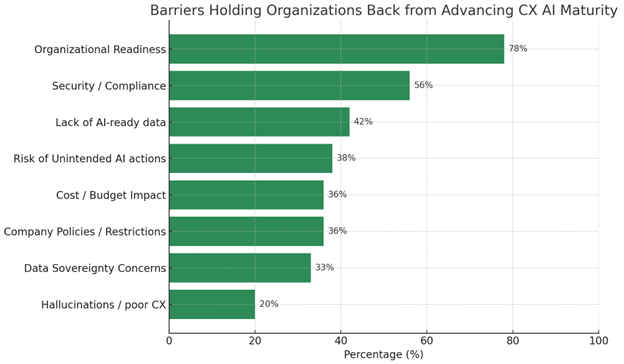
What’s Stopping CX Leaders:
We asked our CX leaders to share what is holding them back:
Why This Matters for CX Leaders:
Knowing the five levels is a roadmap. Ask yourself:
- Are you building a foundation or chasing a finish line? Too often, leaders rush to implement AI features before their data, governance, or teams are ready. Long-term success starts with realistic baselines and a willingness to learn.
- Do you have the right cultural mindset? AI transformation requires curiosity, collaboration, and patience. Teams that view AI as an enabler, not a threat, see faster adoption and more creative use cases.
- Are your metrics evolving with your maturity? Early on, measure efficiency. As you progress, track customer satisfaction, retention, and proactive issue resolution. Aligning KPIs to your maturity level ensures you see and can prove value along the way.
- Are you investing in continuous learning? CX isn’t static, and neither is AI. Make time for feedback loops, retraining, and iteration to keep your AI systems sharp and your people confident.
Because the reality is, AI in CX is extremely valuable—but only when you’re realistic about the journey. Murdoch made it clear, leaders who treat AI as a staged evolution, not a silver bullet, are the ones seeing real ROI.