
Table of contents:
Introduction
In the dynamic landscape of pipeline generation, the challenges of 2023 are a prelude to the complexities awaiting us in 2024.
Our recent report, Evolving horizons: the future of pipeline generation revealed that 45% of senior sales and marketing leaders foresee even greater difficulties in generating pipeline in 2024 compared to the challenges of 2023. With this in mind, optimizing sales and marketing budget spend and strategically prioritizing key areas will be vital to success when it comes to revenue operations in 2024.
From maneuvering through economic uncertainties to leaping into innovative strategies, the path to successful pipeline generation is challenging and ever shifting. The pressing question is: How do you predict the path to success amid such unpredictability?
Through a meticulous analysis of data and insights, we’ve uncovered marketing budget trends that shed light on the strategies senior executives are employing to tackle the uncertainties of the upcoming year.
Past trends, future trajectories: Learning from sales and marketing budgets in 2023
By looking back at the sales and marketing budgetary patterns, we can draw on them to develop predictions for the future trajectories and learn from previous mistakes.
A quick look at the data shows that senior leaders have experienced changing marketing budgets, with a wide range in their budget peaks and troughs. Meanwhile, sales budgets have charted a much steadier course, highlighting their unwavering importance in the process of revenue generation.
Navigating marketing budget peaks and troughs
In 2023, we revealed the shift in marketing focus, discovering that marketers were being expected to do more with dwindling budgets – on average down by 23% from 2021 to 2022.
However, data gathered from our CMO and RevGen Digital Summits found that senior marketers had reported an incredible 334% increase in total budgets in 2023, with the average marketing budget standing at a remarkable $21,153,846.
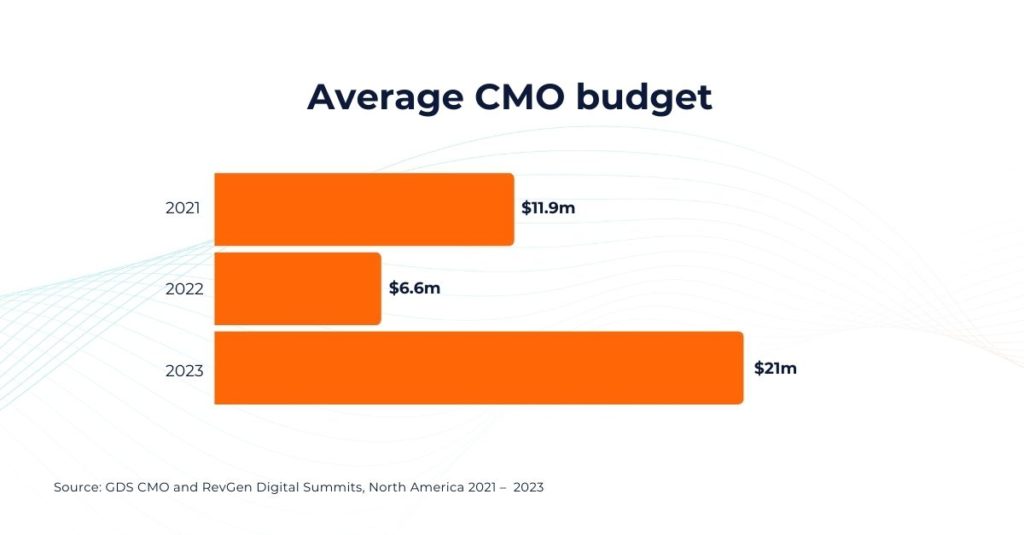
Historical trends highlight the wisdom of investing in brand during economic uncertainty as these investments can mitigate negative impacts and boost the recovery time from these impacts. Therefore, the marketing budget increase could suggest an increased understanding of this insight.
Expanding on this theme, our Beyond the Summit report: CMO edition shed light on the fact that brand strategy and engagement took center stage for many senior marketing executives, which further supports the idea that one of the possible causes for the rise in marketing budgets in 2023 may be the increased recognition of the benefits of brand investment during periods of economic instability.
On the other hand, our report highlighted that only 47% of marketing executives experienced budgetary increases in 2023, while 53% found that their budgets either reduced or stayed the same. This could reflect the differing strategies that businesses employed in response to challenges in pipeline generation – some chose to increase their investments while others focused on cutting back spending.
These opposite approaches may suggest that while some business have truly internalized the significance of brand investment, others may still be catching up.
Sales budgets
It is clear then, that the past few years have seen dramatic changes in budget for senior marketing executives. Meanwhile, their sales counterparts have seen more consistency in their budgets.
Our infographic, ‘Sales and marketing: creating a revenue power house’, revealed that the average sales budget has seen much less variation between 2021 – 2023. While there was a significant dip in 2022, that saw the average sales budget reduce by around 21%, 2023 saw sales budgets increase and overall, the average sales budget has remained somewhat stable.
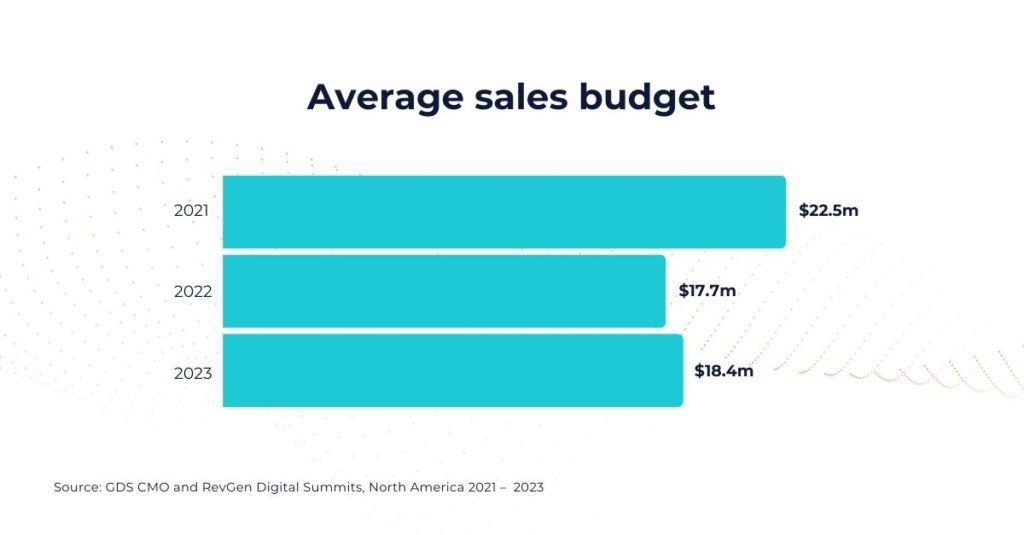
The consistent stability of sales budgets in recent years underscores the enduring significance of the department. While marketing leaders find frequent disparities in their budgets – both from year to year and from company to company – sales leaders appear to be able to rest assured that their budgetary landscape often remains comparatively smooth. That said, sales budgets are still yet to reach the same amount as 2021, where the average budget was cited as $22.5m.
In our report, it was found that 61% of sales leaders experienced these budget increases in 2023. This again suggests that sales leaders experience more consistent trends throughout than those in marketing.
Anticipating sales and marketing budgets in 2024
With both sales and marketing budgets experiencing increases in 2023, it remains to be seen if this upwards trajectory will carry on into 2024. By examining other sources, a promising outlook continues to emerge.
For marketers, the Q4 2023 IPA Bellwether Report, focused on the UK market, indicated that 44.5% of respondents are anticipating expansions in marketing budgets for 2024. Adding to this optimism, LinkedIn found that two thirds of B2B leaders worldwide are also expecting marketing budgets to increase this year. Meanwhile in the realm of sales, Forrester found that 75% of sales leaders are forecasting that they will receive a boost in spending.
So, while historic trends and future anticipations seem to be pointing in the right direction for sales and marketing budgets, what else is ahead for senior executives in 2024?
Economic influences: Shaping sales and marketing budgets in 2024
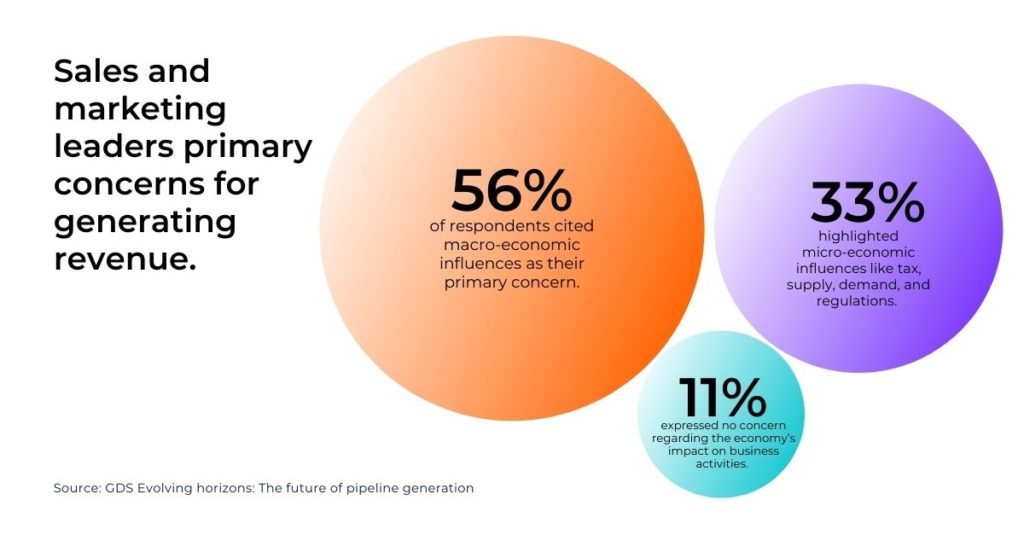
56% of senior sales and marketing executives cited macroeconomic influences as their primary concern when it comes to generating revenue, while 33% focused on microeconomic impact, such as tax, supply, demand, and regulations. It is clear, then, that economic impacts are a key concern for many businesses and are likely to affect sales and marketing budget spending in 2024.
Pivoting pipeline generation strategies
In response to economic shifts and uncertainties, 70% of senior sales and marketing leaders adapted their pipeline generation tactics in 2023. This statistic may be seen in correlation with the 69% of industry leaders who reported that pipeline generation was more difficult in 2023 compared to the previous year, perhaps highlighting that many pivoted their strategies as a reactive approach.
This leads to the question, did pivoting strategies pay off?
The average rating for optimism about the economy stood at 59 out of 100. While this number doesn’t reflect a shining beam of optimism as we enter a new year, it still suggests that many are still maintaining a cautious yet hopeful outlook for 2024.
Such reservation may be attributed to the sudden and disruptive nature of the global COVID-19 pandemic, which forced many businesses across almost every industry to rethink and adapt in order to stay afloat during the tumultuous duration of the pandemic. Furthermore, with its long-lasting economic impacts, the pandemic, or the possibility of similar disruptive events, is likely still lingering in the minds of many industry leaders.
Post-pandemic priorities
Moreover, the pandemic’s continuing impact can also be seen in the revelation that most leaders are now prioritizing short-term performance over long-term growth.
44% of senior sales and marketing leaders reported that they were more centered on short-term performance spanning the next 6 months, while 21% were looking even closer, concentrating on either the next quarter or the next month. This left only 35% of leaders who were considering long-term growth across the next year as their primary focus.
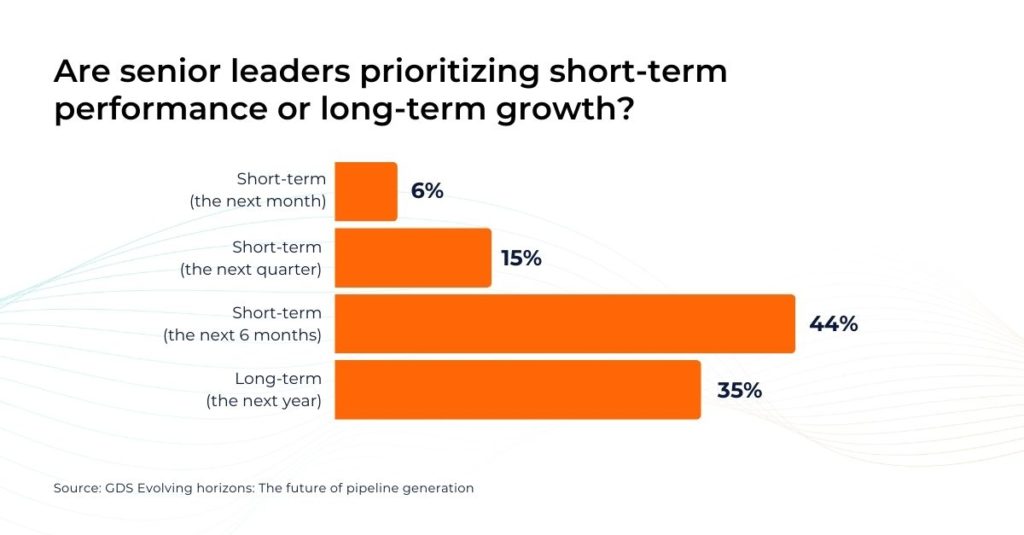
These numbers suggest that quick wins are becoming an important priority for many, with an average of 62% of sales and marketing budgets being attributed to activities taking place within the next 6 months or less.
Strategic technology investments
Another possible cause of this focus on the short-term could be the increasing speed at which technology is evolving. With technological advancements seemingly occurring daily, many leaders wish to keep up with this pace of change.
It will be important to invest sales and marketing budgets wisely into new technologies, as many find themselves selecting short-term tech solutions – yet neglecting to consider the long-term strategy.
Combining the persevering economic uncertainties, the memory of a disruptive and sudden pandemic, and the relentless evolution of technology sets the scene for the almost constant possibility of change. Sales and marketing leaders will need to be prepared for these changes, hence the development of a short-term focus which will help to tackle any immediate challenges.
That said, business leaders should not dismiss the ability to think forward and develop long-term plans for growth – and while it may be difficult to be fully ‘future-proof’, industry leaders should begin to embrace plans that are ‘future-friendly’.
Executive choices: Unraveling sales and marketing budgetary priorities from 2023 to 2024
In 2024, it is reported that 56% of sales and marketing budgets will be allocated to digital activities. This is an increase of 8% compared to the previous year, yet our report demonstrated that this budget will be spread across a much wider array of channels than the budget assigned to offline activities.
This may reflect the ever-evolving digital space, where many marketers are obliged to stretch across a growing number of channels.
In comparison, in the physical world, the options for reliable tried-and-tested marketing channels lead to a reduced split, which has also been further enhanced by a decline in the usage of conventional large-scale media such as TV and radio.
Offline channels
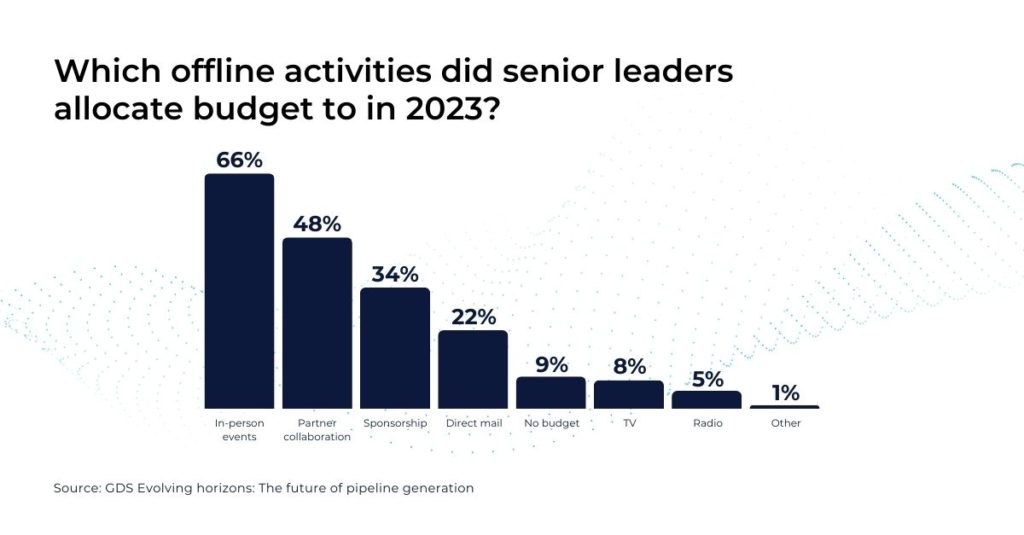
Exploring these spending splits further, the front runner for offline sales and marketing budget allocation was in-person events, with 66% of sales and marketing leaders indicating that they allocated budget to them in 2023.
This focus on in-person events is set to continue well into 2024, as 68% of sales leaders feel that they are likely to apply budget to them in the next 12 months. While the number of marketing leaders applying budget here is lower (48%), in-person events are still within the top three activities for 2024, likely due to their previous success in generating pipeline in 2023.
This emphasis on in-person events highlights the value of face-to-face interactions, which build deeper relationships and long-lasting connections.
Other notable offline activities that experienced sales and marketing budget allocation in 2023 include partner collaboration and sponsorship, being allocated budget by 48% and 34% of senior sales and marketing executives, respectively. This represents an increased focus on developing more targeted strategies for generating pipeline.
In contrast, TV and radio saw little budget allocation in 2023, likely due to their more large-scale approach, which falls in line with the targeted methods that are proving more effective.
Online channels
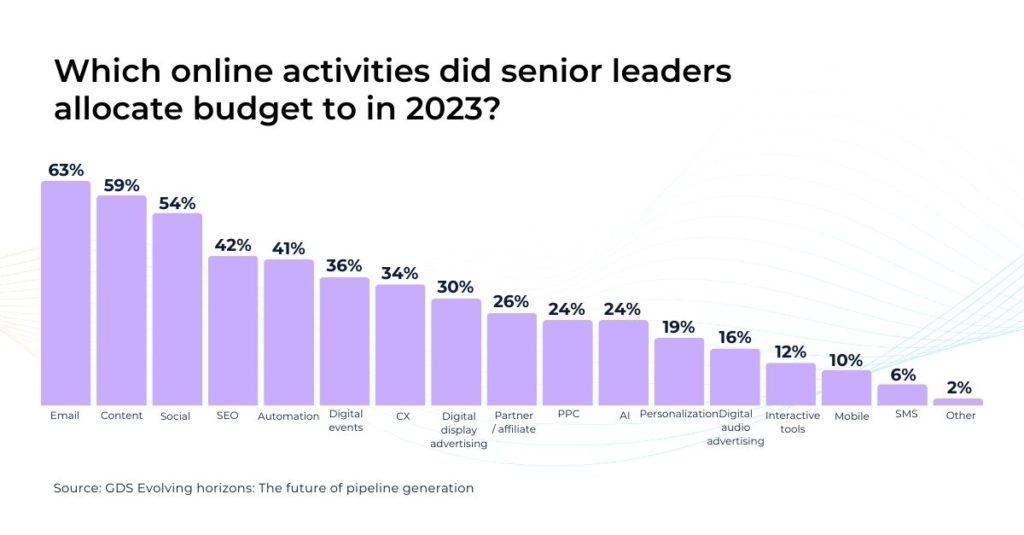
Online channels experienced sales and marketing budget allocations over a much larger selection of activities in 2023, though the top activity – email marketing – suggests a move towards strategically targeted pipeline generation strategies: online, as well as offline.
This is further enhanced by the significance of marketing automation, highlighted by 41% of senior executives as a key area for sales and marketing budget allocation, and personalization which received budget from 19% of industry leaders. Both activities can further aid in crafting streamlined automated email strategies for delivering targeted personalization at scale.
Activities that were also found to receive sales and marketing budget in 2023 included social advertising and SEO. As websites rank as the fourth most effective method in driving pipelines, the focus on these two activities serves as no surprise, due to their proven ROI.
At the other end of the scale, mobile channels, such as mobile marketing and SMS advertising saw reduced investments, having proven less effective for B2B outreach. These reductions are set to continue into 2024, with only 3% of sales leaders planning on investing in mobile / apps, and, while a larger percentage of marketing leaders have designs to allocate budget in this area (10%), it still ranks at the bottom of the list.
Events: 2024’s secret weapon
While in-person events have already been previously mentioned, it would be remiss to neglect looking at events as a whole.
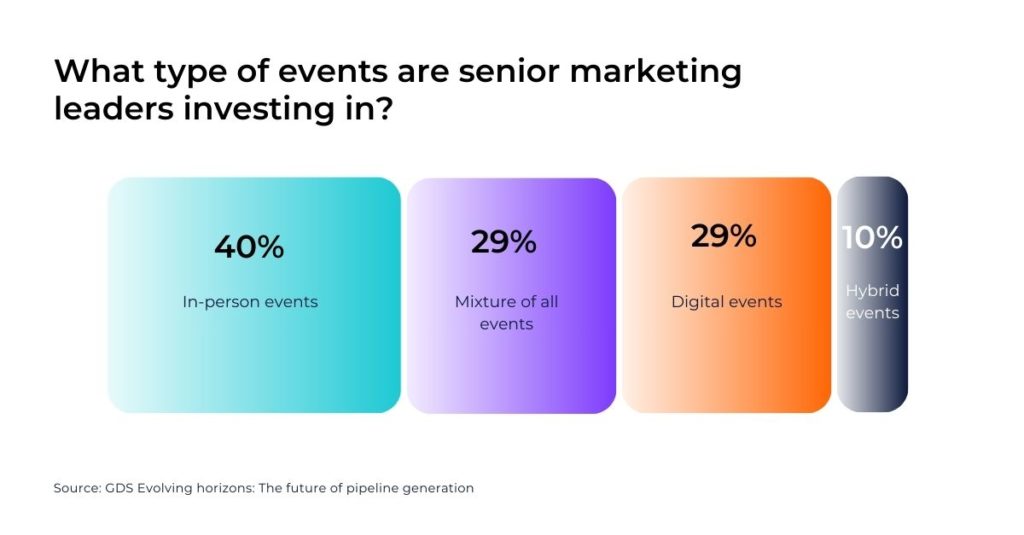
A staggering 93% of leaders are intending on leveraging events in 2024 – whether physical or digital. Evidently, this channel may well be the decisive key player in strategies for the year ahead. Having proven their worth as the top channel for driving pipeline, it is no surprise that in-person events will receive the greatest sales and marketing budget investment, with 40% opting for this type of event.
Additionally, a substantial proportion of executives are planning on taking a blended approach to their event marketing strategies, with 29% revealing that they intend to assign sales and marketing budget to both in-person and digital events.
Many hope to achieve incredible outcomes with these events, the top three cited by sales and marketing leaders included accelerating profitable revenue growth, increasing brand awareness, and net new logo acquisition. However, achieving these outcomes will mean utilizing events strategically, with impactful and effective events that will reach the intended audiences. Which will take time, staff, resources, budget and more.
The top challenge indicated by 21% of sales and marketing leaders was a lack of staff and / or resources. This was closely followed by the challenge of reaching the right audience and difficulties with measuring ROI.
One way that senior executives could overcome these barriers is by engaging third-party event specialists, such as GDS Group, who can bring their expertise to oversee and optimize the execution of events.
Key findings
- 45% of senior leaders are anticipating greater difficulties in pipeline generation in 2024, however many senior executives are staying hopeful, with positive outlooks in their sales and marketing budgetary expectations.
- Despite the economic challenges, marketing budgets have seen increases, with the average budget increasing a remarkable 334% in 2023 and 47% of marketers experiencing a budget increase. Meanwhile sales budgets have remained stable in 2023.
- Macro and microeconomic influences are key concerns for 56% of senior executives, with 70% adapting pipeline generation tactics in response to economic shifts in 2023.
- With a focus on quick wins and short-term strategies, 44% of leaders are prioritizing short-term performance over long-term growth.
- 56% of sales and marketing budgets allocated to digital activities in 2024, an 8% increase from the previous year.
- In-person events remain a significant focus, with 93% of leaders intending to leverage them in 2024.
Conclusion
From exploring the details of sales and marketing budgets, this year and last, it becomes evident that the landscape of pipeline generation is ever evolving. The optimism demonstrated in various reports hints at a positive trajectory for marketing and sales budgets.
However, this optimism is tempered by an unstable economic landscape. Senior executives find themselves treading the line between short-term performance demands and the imperative to develop future-friendly plans for sustained growth.
In regard to sales and marketing budget allocation, the surge in digital activities underscores the continued dominance of the online space. Simultaneously, the enduring importance of in-person events signifies a recognition of the irreplaceable value of face-to-face interactions in forging lasting connections.
The emphasis on events as a key player demands strategic execution, overcoming challenges such as resource constraints and audience reach.
About the data
Unless otherwise stated, the data in this blog is based on the results of our annual survey: the future of pipeline generation, which was conducted between 5 September 2023 and 31 October 2023.
The data collected in this survey collated the responses of 346 B2B and B2C global sales and marketing leaders, all of which met stringent qualification criteria.
To explore these results in further detail and unlock all the data gathered from our research, download the report: Evolving horizons: the future of pipeline generation.
Feature your marketing solutions to industry leaders
Are you ready to showcase your tech solutions in front of senior decision makers? Partner with us on our next summit.